Fewer sales, yet prices keep rising
In 2026 the Spanish market is moving in two directions at once: fewer homes are changing hands, but prices keep climbing. According to notary data, 181,206 homes were sold in the second quarter of 2026. That’s 9% fewer than a year earlier.
At the same time, the average price rose to €2,094/m², a 10% annual increase and the fastest since 2022. Over five years, the average home price has gone up by 44%. The reason is simple: supply is short, especially of well-located properties with their paperwork in order.
Financing has become more expensive. The 12-month Euribor closed July at 2.855%, up from 2.08% a year earlier, and in early October it has been hovering around 3%. That makes many buyers more cautious, and it shows in the sales figures.
Costa Blanca and Jávea: pricier, but still in demand
Here the trend is even sharper. According to the notaries, the Valencia region saw the steepest drop in sales in Spain (–35.8%), while prices rose by 11.9%. In the first quarter, Alicante province had the fourth-fastest price growth in the country.
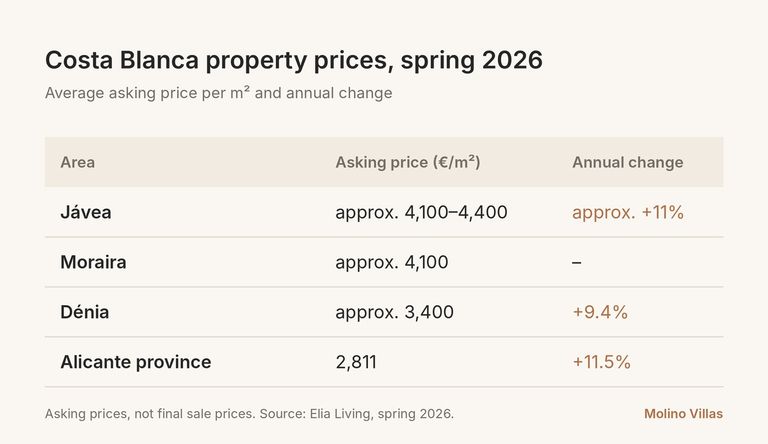
AreaAverage asking price (€/m²)Annual change
These are asking prices, not actual sale prices.
What I see day to day: well-priced homes in good condition still sell quickly. Overpriced ones, on the other hand, sit on the market for months. Buyers today ask more questions and check things more carefully, and that’s a good thing.
Politics and regulation: 29 November is the key date
The biggest news: Spain will hold a snap general election on 29 November 2026. Prime Minister Pedro Sánchez dissolved parliament after the government’s emergency housing measures were rejected on 2 October.
What does this mean in practice?
- The proposed tax of up to 100% on non-EU buyers is not law. The proposal has stalled in parliament, and it wasn’t part of the rejected package either. Whether it comes back depends on the election manifestos.
- The Golden Visa has already ended. It closed on 3 April 2025, so buying property no longer gives you a residence permit.
- Holiday rentals have become stricter, and may get stricter still. The government wants holiday lets taxed more like a business, while the opposition promises more supply and fewer restrictions.
If you’re counting on rental income to make a purchase work, now is the time to check local licences especially carefully. We do this for every property, as a matter of course.
Honestly: who should buy now?
I’m not going to tell you it’s “now or never”. That isn’t true, and it isn’t how we work. What I can tell you is who I think should move now, and who might be better off waiting.
It’s a good time if:
- you want to live here, or use your home for the long term, because then short-term political uncertainty matters less;
- you’re an EU buyer and your decision doesn’t depend on a mortgage;
- you’ve found a property that truly feels like yours. There aren’t many of those, and the good ones don’t wait.
Consider waiting or planning more carefully if:
- your main goal is holiday rental income;
- you’re a non-EU buyer and want more clarity after the 29 November election;
- you’d rely on a variable-rate mortgage that a rate rise would strain.
Whichever group you’re in, the most important thing is this: don’t let the market make your decision. Let it come from what you want your life here to be.
Let’s talk
Numbers tell you a lot, but not what’s right for you. If you’re thinking about finding a home on the Costa Blanca, whether now, next year or just someday, I’d love to sit down with you for a coffee, in person or online. Not to sell you anything, but to get to know you and tell you honestly what I see.
Because, as I always say: following your heart will never disappoint you.
– Katalin and the Molino Villas team